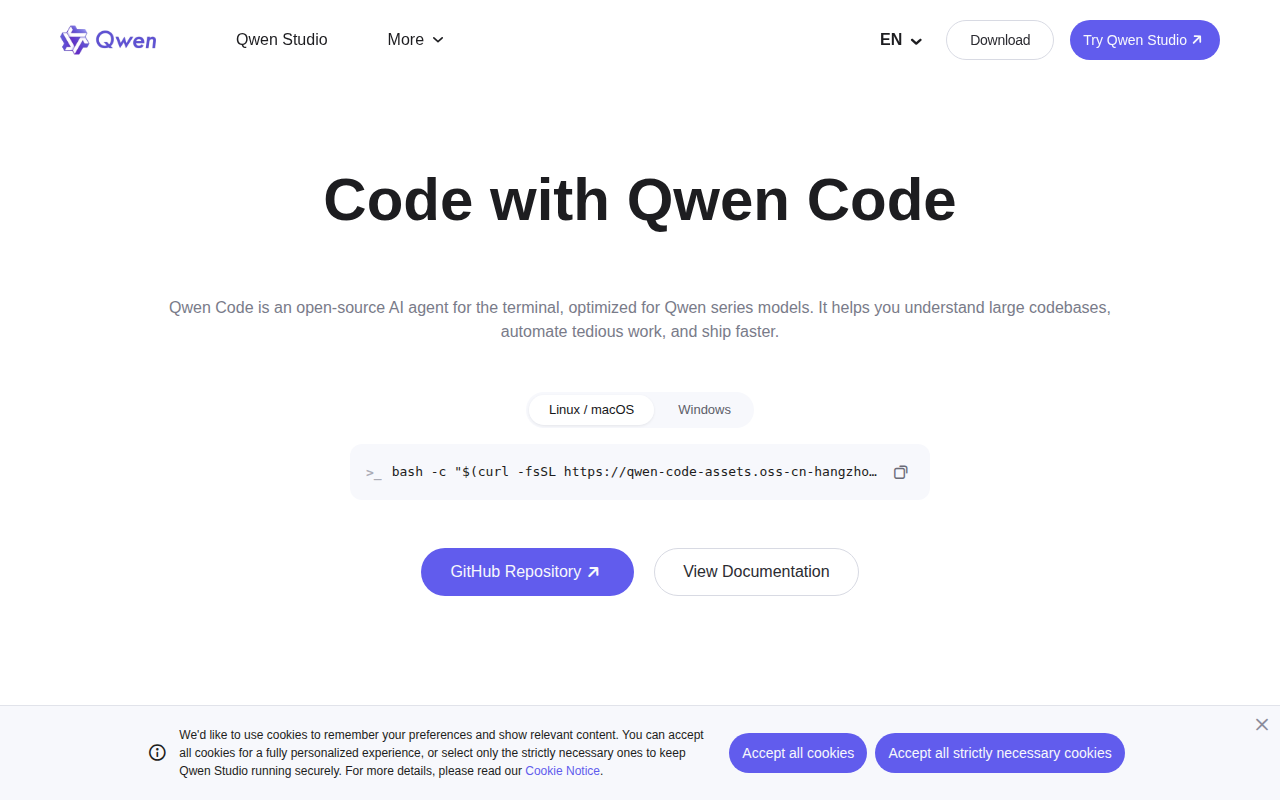
Qwen Code: A GitHub Copilot Alternative for CLI Agent Workflows
Qwen Code is a cli agent developed by Qwen / Alibaba Cloud. Its clearest differentiator is open-source terminal agent built for coding workflows. As a GitHub Copilot alternative, it is best suited for developers who value qwen code is best for developers who want an open-source terminal agent, care about provider choice, and are comfortable managing api access instead of buying a single bundled seat.
Qwen Code vs. GitHub Copilot: Quick Comparison
| Qwen Code | GitHub Copilot |
|---|
| Type | CLI Agent | IDE Extension / CLI |
| IDEs | CLI and CI-oriented workflows; additional IDE support is not clearly documented on the official landing page | VS Code, JetBrains, Vim, Neovim, Visual Studio, Xcode |
| Pricing | Open-source CLI; the former OAuth free tier ended on April 15, 2026, and ongoing usage now requires Alibaba Cloud Coding Plan, OpenRouter, Fireworks AI, or your own API key | Free for students/OSS; Individual $10/mo; Business $19/mo; Enterprise $39/mo |
| Models | Qwen series models; exact context window for the product flow is not publicly documented on the landing page | Multi-model cloud service |
| Privacy / hosting | Flexible provider model using Alibaba Cloud or other compatible API providers | Cloud service |
| Open source | Yes | No |
| Offline / local models | Not publicly documented on the official landing page | No |
Key Strengths
- Open-source positioning: Qwen Code is publicly presented as an open-source AI agent that lives in the terminal. That matters because buyers can inspect the project, follow releases, and evaluate community momentum directly. Copilot does not offer that level of implementation visibility.
- Provider flexibility: The official project materials emphasize multiple provider options, including Alibaba Cloud Coding Plan, OpenRouter, Fireworks AI, and bring-your-own API key flows. That lowers lock-in risk for teams that want to choose cost, region, or model stack independently. It is a practical advantage over more vertically integrated coding assistants.
- Terminal-first focus: Qwen Code is opinionated about terminal and automation workflows instead of only editor-side completion. That makes it attractive for developers who script their workflow, work in CI, or want a coding agent that feels closer to an automation tool than a chat sidebar.
Known Limitations
- No longer free by default: The official repository notes that the OAuth free tier was discontinued on April 15, 2026. That means the headline value is no longer a plug-and-play free experience for most new users. Developers now need to think about provider billing much earlier in the evaluation process.
- Pricing is indirect: There is no simple one-price public subscription for Qwen Code itself on the official landing page. Instead, cost depends on which provider or plan you route it through. That flexibility is useful, but it also makes comparison shopping less straightforward than fixed-seat alternatives.
- Terminal-first learning curve: Qwen Code is best understood as a terminal agent rather than a beginner-friendly autocomplete add-on. Developers who want instant comfort inside a mainstream editor may face a steeper ramp. GitHub Copilot still wins on familiarity for many generalist teams.
Best For
Qwen Code is best for developers who want an open-source terminal agent, care about provider choice, and are comfortable managing API access instead of buying a single bundled seat. It also suits technically opinionated teams that want to inspect the project and track release velocity openly. It is less ideal for organizations that want a simple one-line procurement story.
Pricing
- CLI software: Open source and publicly available.
- Free OAuth tier: Discontinued on April 15, 2026.
- Ongoing usage: Requires Alibaba Cloud Coding Plan, OpenRouter, Fireworks AI, or your own API key/provider.
Prices are subject to change. Check the official pricing page for current details.
Tech Details
- Type: CLI coding agent
- IDEs: Terminal and automation workflows
- Key features: open-source codebase, provider flexibility, and coding-task automation
- Privacy / hosting: Depends on the provider you configure
- Models / context window: Qwen series models; exact public context size not documented on the official landing page
When to Choose This Over GitHub Copilot
- Choose Qwen Code when you want an open-source terminal agent rather than a closed commercial coding assistant.
- Choose it when provider flexibility matters because you want to manage pricing, region, or model choice yourself.
- Choose it when terminal and CI-style automation are more important than mainstream editor comfort.
Qwen Code is strongest when the buyer specifically wants choose qwen code when you want an open-source terminal agent rather than a closed commercial coding assistant..
It also stands out when provider flexibility matters because you want to manage pricing, region, or model choice yourself..
For procurement, a match usually depends on whether terminal and ci-style automation are more important than mainstream editor comfort..
When GitHub Copilot May Be a Better Fit
- GitHub Copilot may be a better fit if you want a simpler commercial purchase model with less provider setup.
- Copilot may also win when your team prioritizes familiar editor workflows over terminal-agent power.
- If procurement simplicity and mainstream documentation matter most, Copilot remains the safer default.
Feature Deep Dive
Qwen Code is not only about generating text inside an editor. Its public materials emphasize open-source terminal agent built for coding workflows, which shifts the product toward a workflow tool instead of a simple assistant. For developers comparing agent products, that difference matters because it changes how much autonomy the tool can bring to real tasks.
The integration surface also shapes the product's value. CLI and CI-oriented workflows; additional IDE support is not clearly documented on the official landing page gives Qwen Code more room to participate in full tasks rather than isolated completions. That can improve flow for developers who constantly switch between reading code, changing files, and checking results.
Pricing and buying clarity are another part of the evaluation. The official repository states the OAuth free tier ended on April 15, 2026 and directs users to Alibaba Cloud Coding Plan, OpenRouter, Fireworks AI, or their own API key/provider for continued use. Buyers should still compare real usage patterns because agent products can feel affordable at light usage and expensive at sustained heavy usage. That makes direct cost-per-workflow evaluation more honest than headline sticker price alone.
The most practical test is whether the product matches your working style. If you mainly want low-friction inline completion, a classic assistant may still be enough. If you want more explicit task execution, session-based work, or environment-aware help, Qwen Code deserves a closer look.
Developers also need to consider governance and control. Flexible provider model using Alibaba Cloud or other compatible API providers That may be perfectly acceptable for many teams, but not for everyone. The important point is that buying decisions should follow deployment and policy reality, not only demo quality.
Finally, community evidence matters because it shows whether a tool is being actively discussed and evaluated outside its own marketing pages. The external links collected for this listing point to reviews, explainers, or news coverage that help buyers understand how the market is reacting. That kind of signal is especially useful when a product is still building recognition.
Use Cases and Workflow Fit
For solo developers, Qwen Code can be attractive when the tool's default interaction model matches their habits. Terminal-first builders often prefer agents that can keep working through filesystem, command, and planning steps without forcing them into a purely chat-driven editor sidebar.
For startup teams, the decision usually comes down to tradeoffs between familiarity and workflow leverage. GitHub Copilot remains the standard benchmark because it is everywhere. Qwen Code becomes attractive only when its special workflow advantage clearly saves time or reduces switching.
For larger organizations, rollout questions extend beyond model quality. Teams need to know how access is granted, how usage is measured, where prompts and code are processed, and how product boundaries fit current tooling. That is why the public pricing and deployment notes matter as much as feature demos.
For evaluation, a useful pilot is to compare one realistic engineering task in both tools. Ask each product to understand a medium-size repo, plan a change, implement it, and explain tradeoffs. That exposes whether the product is merely good at suggestion quality or genuinely better for task completion.
A second evaluation path is to compare friction. Installation, authentication, IDE fit, and cost predictability all shape whether a tool remains useful after the novelty wears off. A strong AI agent that feels awkward every day can still lose to a simpler product that fits the team's habits better.
The healthiest conclusion is usually conditional, not absolute. Qwen Code is not universally better than GitHub Copilot, but it can be the more rational choice for buyers whose constraints line up with the product's strongest design decisions.
Conclusion
Qwen Code is worth shortlisting when its core workflow advantage is the real reason you are leaving GitHub Copilot. The product is strongest for buyers whose toolchain, budgeting model, or interface preferences line up with what it actually ships today. If those conditions do not apply, GitHub Copilot may still remain the more practical default.
Sources
FAQ
Is Qwen Code free?
Open source and publicly available.
Does Qwen Code work with VS Code?
CLI and CI-oriented workflows; additional IDE support is not clearly documented on the official landing page.
How does Qwen Code compare to GitHub Copilot?
Qwen Code is stronger when its specific workflow advantage matters more than broad default familiarity. It is weaker when a buyer mainly wants the lowest-friction mainstream editor experience with minimal setup choices.
Is Qwen Code still free?
The official repository says the OAuth free tier ended on April 15, 2026. The CLI remains open source, but active use now depends on a configured provider such as Alibaba Cloud Coding Plan, OpenRouter, Fireworks AI, or another supported API key flow.