Dreamflow: A GitHub Copilot alternative for ai app builder workflows
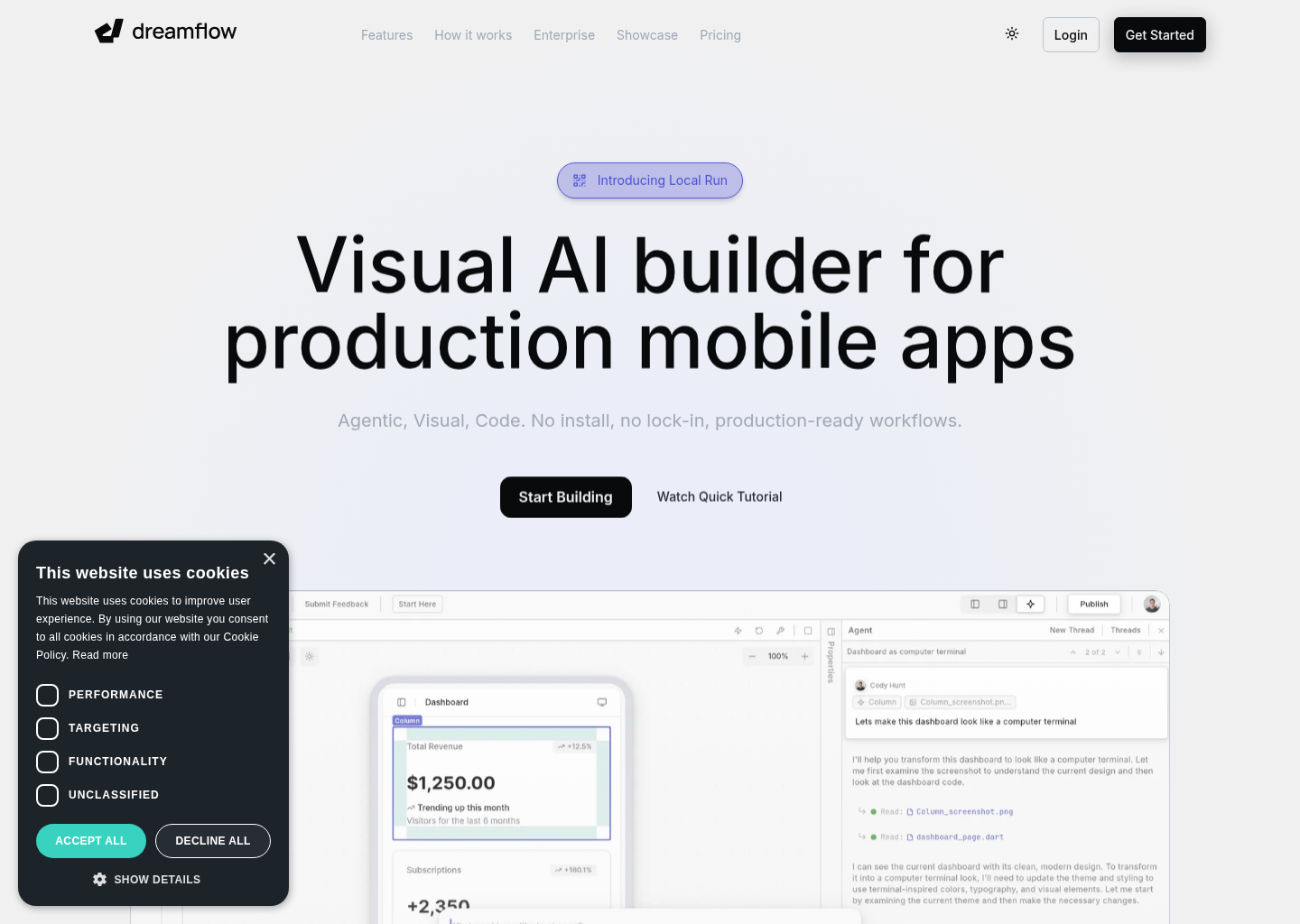
Dreamflow is a AI App Builder developed by Dreamflow / FlutterFlow team. Visual AI builder from the FlutterFlow team that combines prompting, visual canvas, code editing, and cross-platform deployment for web and mobile app creation. As a GitHub Copilot alternative, it is best suited for teams that want a different balance of control, interface, and workflow scope than a classic IDE assistant provides.
Quick Comparison
| Dreamflow | GitHub Copilot |
|---|
| Type | AI App Builder | IDE extension and chat / completion assistant |
| Primary surface | Browser-based builder with code export and deployment workflows rather than a classic IDE plugin | VS Code, JetBrains, Visual Studio, Xcode, Neovim, CLI |
| Pricing | Free plan at $0 per month with 10 starter credits and web deployment | Free for students and OSS; Individual $10/mo; Business $19/mo; Enterprise $39/mo |
| Models | Not publicly documented | GitHub-managed multi-model routing on supported plans |
| Privacy / hosting | One-click deployment for web on the free tier, with App Store and Play Store deployment on paid plans | Cloud (GitHub / Microsoft) |
| Open source | No | No |
| Offline / local models | No | No |
Key Strengths
- It combines prompt, visual, and code editing in one loop: Lovable is simpler because it keeps the workflow more prompt-first and product-centric. Dreamflow is more flexible when the team wants to move between AI generation, visual adjustments, and direct code control without switching tools.
- It is stronger for cross-platform ambition: Dreamflow can deploy to Web, iOS, and Android, which makes it more attractive when the project is not purely a web MVP. Lovable is usually the cleaner choice when the product is web-only and the team wants less surface-area complexity.
- It offers a more balanced designer-developer bridge: The visual canvas matters. Teams that want a builder where product, design, and code perspectives stay connected may find Dreamflow more collaborative than Lovable, even if it also asks more from the user.
Known Limitations
- It is less obvious: It is less obvious than Lovable for completely non-technical founders who only want the fastest path to one web app.
- The Flutter and cross-platform: The Flutter and cross-platform orientation can be overkill for teams that do not care about mobile or code-level control.
Best For
founders, designers, product teams, and builders who want one workflow that mixes prompts, visual editing, code access, and cross-platform deployment across web and mobile
Pricing
- Free plan: Free plan at $0 per month with 10 starter credits and web deployment
- Paid plans: Hobby starts at $20 per month with full code export and mobile deployment; Pro is $90 per month with Git and premium-model access; Enterprise is custom
- Pricing notes: Dreamflow's pricing is refreshingly explicit for a newer AI builder, with clear Free, Hobby, Pro, and Enterprise levels instead of vague usage-only messaging.
Prices and free-tier terms can change. Check the official pricing source for current details.
Tech Details
- Type: AI App Builder
- IDEs: Browser-based builder with code export and deployment workflows rather than a classic IDE plugin
- Key features: Context-aware AI generation with iterative edits that stay synced across prompt, visual, and code surfaces, A core differentiator; Dreamflow explicitly sells the combination of AI generation, visual canvas, and code sync, One-click deployment for web on the free tier, with App Store and Play Store deployment on paid plans, Version control and Git are part of the Pro tier according to the public pricing section, Firebase and Supabase integrations are highlighted as built-in backend options, Not exhaustively documented on the homepage, but full app workflows and backend integrations imply production-ready auth patterns
- Privacy / hosting: One-click deployment for web on the free tier, with App Store and Play Store deployment on paid plans
- Models / context window: Not publicly documented
Workflow Fit
Compared with Lovable, Dreamflow fits teams that do not want to choose between AI generation, visual editing, and code access. It is most compelling when the app's life will move across those three surfaces repeatedly.
It is less ideal when the only requirement is to ship one web-first MVP quickly and the team gains little from the extra flexibility.
What Changes Compared with a Classic Copilot Workflow
The biggest shift is not model branding. It is operating model. GitHub Copilot is usually judged inside an editor-centered routine where inline suggestions, chat, and light task help happen beside normal coding. Dreamflow changes that center of gravity.
In practice, that means a buyer should ask whether the team wants the assistant to stay inside the current editor habit or whether it wants a bigger workflow change. Some teams genuinely benefit from a browser builder, a shell-native harness, or a broader agent surface. Other teams only need better suggestions in the tools they already use every day.
Operational Tradeoffs
Every credible coding or building tool has a hidden operational story behind the feature list. Teams are not only choosing where code gets generated. They are also choosing where review happens, how context is carried across tasks, how cost pressure shapes behavior, and whether the workflow still feels natural after the novelty wears off.
That is why Dreamflow should be judged on the habits it encourages. If it nudges the team toward a workflow that matches the real job, the product can outperform a more famous tool. If it nudges the team away from the daily reality of engineering, even strong capabilities can turn into overhead.
Implementation Considerations
Implementation success usually depends less on whether a product can generate code and more on whether the team can absorb the workflow it imposes. A team moving to Dreamflow should decide who owns prompts, where validation happens, how generated output is reviewed, and when a task should stay manual instead of being delegated.
The reviewed official sources make it clear that Dreamflow is designed around a specific operational center of gravity. When that center matches the team's real daily behavior, adoption feels natural. When it does not, even good features can end up underused because the surrounding workflow never becomes comfortable.
Adoption Notes
Adoption also depends on the maturity of the surrounding engineering process. Early-stage founders may value speed and flexibility first, while established teams may care more about repeatability, governance, editor fit, and whether the tool can carry context across many contributors without creating a second opaque workflow that nobody fully owns.
That is why the safest way to evaluate Dreamflow is to match it to one recurring job: shipping a feature, building an MVP, automating a research-heavy coding task, or getting a prototype into a stakeholder-visible state faster than a human-only process would allow. If it wins there consistently, broader rollout becomes much easier to justify.
Community Feedback
External coverage tends to praise Dreamflow for combining AI speed, visual control, and code-level access in a way that feels more production-aware than many demo-first AI builders. The common caution is complexity: it shines more when the team actually needs that extra breadth.
Across external reviews, the repeating tradeoff is that Dreamflow can be stronger when the job is app formation and delivery, but weaker when the job is repository-native day-to-day engineering.
Decision Lens
A simple way to think about the decision is to ask what problem the tool is really solving. If the pain is inline acceleration inside an IDE, one class of product wins. If the pain is browser-led product formation, another class wins. If the pain is terminal automation and harness control, a different class wins again.
By that standard, Dreamflow should not be judged only on raw intelligence claims. It should be judged on whether its public workflow story lines up with the kind of engineering or product work your team repeats every week. When that fit is real, the product can outperform tools that look stronger on paper but pull the team toward the wrong operating model.
When to Choose This Over GitHub Copilot
- Choose Dreamflow when the team wants prompts, visual editing, code access, and cross-platform delivery in one builder-first workflow.
- Choose Dreamflow when mobile-capable app creation matters as much as web output and the project benefits from a shared visual canvas.
- Choose Dreamflow when product, design, and engineering all need one surface for generation and refinement instead of an editor-only assistant.
When GitHub Copilot May Be a Better Fit
- GitHub Copilot is a better fit when the team mainly works inside an existing repository and wants inline assistance without changing its development surface.
- GitHub Copilot is a better fit when editor-native chat, completions, and small iterative edits matter more than builder-led app generation.
- GitHub Copilot is a better fit when Dreamflow would add too much workflow change for a team that really needs a coding assistant, not an app-building platform.
Conclusion
Dreamflow is a credible option for teams that want a different tradeoff than GitHub Copilot provides by default. The strongest case for it appears when the preferred workflow surface, governance needs, or customization appetite clearly match the product's public strengths.
If those conditions are true, Dreamflow can be the better operational choice even when GitHub Copilot remains the simpler or more familiar assistant. If those conditions are not true, the extra surface area or workflow change can become overhead instead of leverage.
Sources
FAQ
Is Dreamflow free to try?
Yes. Free plan at $0 per month with 10 starter credits and web deployment
What kind of GitHub Copilot alternative is Dreamflow?
Dreamflow is positioned as a AI app builder rather than a classic IDE assistant. Its value comes from builder-first app creation, not just inline code suggestions.
Who should choose Dreamflow over GitHub Copilot?
Choose Dreamflow when the team wants prompts, visual editing, code access, and cross-platform delivery in one builder-first workflow.
When should a team stay with GitHub Copilot instead?
GitHub Copilot is a better fit when the team mainly works inside an existing repository and wants inline assistance without changing its development surface.