Qoder: A GitHub Copilot Alternative for Agentic Multi-Platform AI Coding
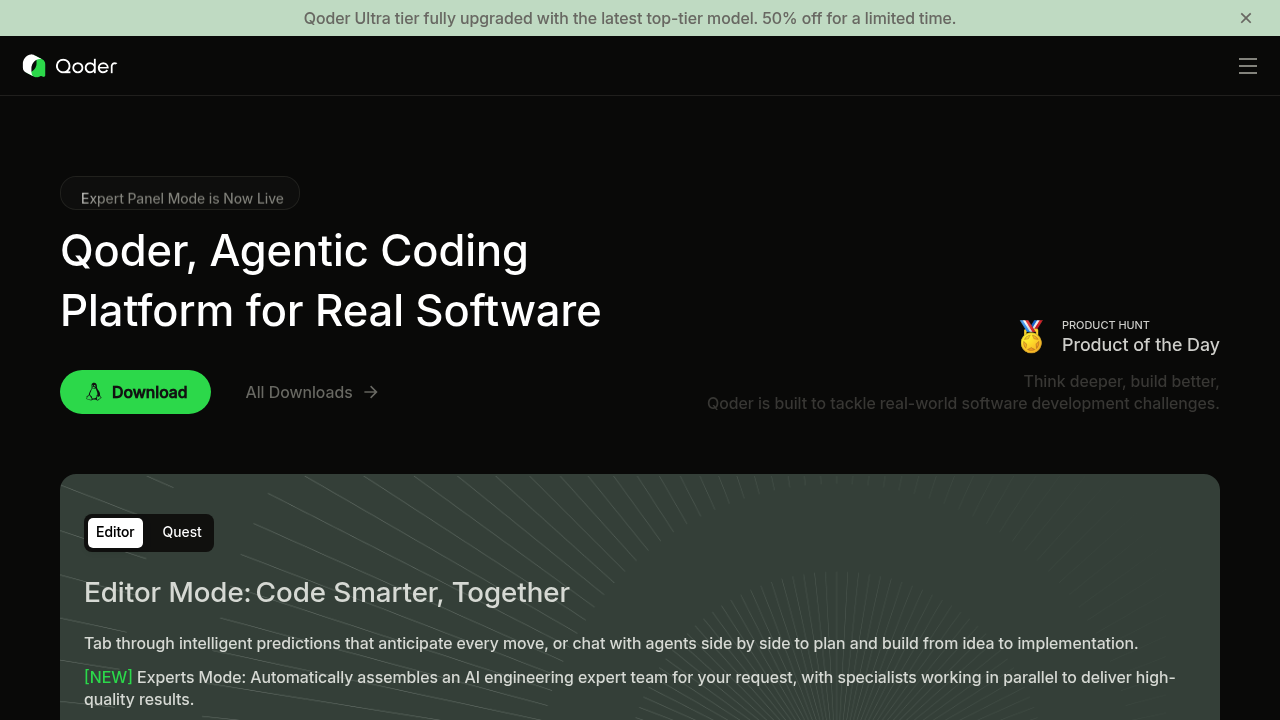
Qoder is an agentic coding platform developed by Qoder Inc., offering a standalone AI IDE, JetBrains plugin, and CLI that combine code completion, test generation, and autonomous agent workflows in a single product. It is designed around "Quest Mode" — a multi-agent system for delegating complex development tasks — alongside standard inline completion and Repo Wiki for codebase-wide context. As a GitHub Copilot alternative, Qoder is best suited for developers who want a single subscription that covers inline completion, test generation, and agent-driven task automation across multiple platforms.
Qoder vs. GitHub Copilot: Quick Comparison
| Qoder | GitHub Copilot |
|---|
| Type | AI IDE + IDE Extension (JetBrains) + CLI | IDE Extension / CLI |
| IDEs | Standalone app (Windows, macOS, Linux), JetBrains plugin, CLI | VS Code, JetBrains, Vim, Neovim, Visual Studio, Xcode |
| Pricing | Free (limited, daily quota); Pro ~$20/month | Free for students/OSS; Individual $10/mo; Business $19/mo; Enterprise $39/mo |
| Models | Latest frontier models (not publicly enumerated per plan); model-flexible | OpenAI GPT-4o, Claude 3.5 Sonnet, Gemini 1.5 Pro (multi-model) |
| Privacy / hosting | Cloud | Cloud (GitHub/Microsoft) |
| Open source | No | No |
| Offline / local models | No (cloud-based) | No |
Key Strengths
- Multi-Platform Coverage in One Subscription: Qoder ships a standalone desktop IDE, a JetBrains plugin, and a CLI under a single product. Developers who use both a JetBrains IDE and occasionally work from the terminal get consistent AI capabilities without managing separate subscriptions for each environment. GitHub Copilot covers more editor variety, but Qoder's JetBrains + desktop IDE + CLI combination is a strong match for JetBrains-first teams who also want a standalone agentic option.
- Quest Mode: Multi-Agent Task Delegation: Quest Mode is Qoder's agent system for delegating complex, multi-step development tasks. Unlike single-round chat, Quest Mode allows the platform to decompose a goal into sub-tasks, execute them across files, and report progress. This positions Qoder as an agentic platform rather than just an autocomplete extension — a meaningful distinction for developers who want delegation, not suggestion.
- Repo Wiki for Codebase-Wide Context: Qoder's Repo Wiki indexes the entire repository and provides structured documentation and navigation for the codebase. This enables agents and chat to reason about the project as a whole rather than the currently open file, reducing the context-switching overhead that degrades AI suggestion quality on large codebases.
- Test Generation as a First-Class Feature: Qoder positions test generation as a core capability alongside code completion, not an afterthought. This is particularly relevant for teams working on TDD or projects with coverage requirements, where generating and validating tests alongside code changes reduces the manual effort typically left out of AI coding workflows.
- Free Tier with Daily Access: Qoder offers a free plan with daily credit limits for basic model access, making it accessible to developers who want to evaluate agentic coding workflows before committing to a Pro subscription. This is a practical on-ramp that GitHub Copilot only matches for students and open-source contributors.
Known Limitations
- No VS Code Extension: Qoder does not currently offer a VS Code extension. Developers whose primary editor is VS Code must either adopt the standalone Qoder IDE (which is a VS Code-style editor) or work without Qoder's JetBrains plugin coverage in their existing editor. This is a meaningful gap compared to GitHub Copilot's first-class VS Code support.
- Model Transparency Limited: Qoder's pricing page and documentation do not explicitly enumerate which models are available per plan tier. This makes it difficult to compare model quality directly against Copilot or evaluate whether the available models justify the Pro subscription price for specific use cases.
- Cloud-Only with No BYOK Option: As a managed cloud platform, Qoder does not currently support BYOK or local model execution. Developers with enterprise API contracts or data residency requirements cannot customize the model backend or avoid routing code through Qoder's cloud infrastructure.
- Smaller Community and Ecosystem: Qoder is a newer platform with a smaller community, fewer integration tutorials, and less production track record than GitHub Copilot. Teams evaluating long-term tooling risk should factor in ecosystem maturity alongside feature comparisons.
Best For
Qoder is best suited for JetBrains-first development teams who want to add agentic task delegation and test generation to their workflow within a single subscription. Its standalone IDE option is a good fit for developers comfortable adopting a new editor who want a complete AI-native environment rather than bolting an extension onto an existing one. The free tier makes it accessible for solo developers evaluating agent-mode workflows before committing to a paid plan. Teams that require VS Code support or BYOK model flexibility will find better coverage with other tools in this directory.
Pricing
- Free: $0/month — daily credit limit on basic model; limited access to Chat/Agent features, code completion.
- Pro: ~$20/month — generous monthly credit quota; all features including Quest Mode, Repo Wiki, premium models.
Prices are subject to change. Check the official pricing page for current details. Pricing noted as of September 2025 review; verify current tiers on the official site.
Tech Details
- Type: AI IDE (standalone) + IDE Extension (JetBrains) + CLI
- IDEs: Standalone desktop app (Windows, macOS, Linux), JetBrains plugin, CLI
- Key features: Code completion, test generation, Quest Mode (multi-agent), Repo Wiki (codebase indexing), AI chat, structured design artifacts (Spec, Action Flow, Task Report)
- Privacy / hosting: Cloud
- Models / context window: Latest frontier models; specific models not publicly enumerated per plan tier
When to Choose This Over GitHub Copilot
- You use JetBrains IDEs and want a tool that combines inline completion, test generation, and multi-agent task delegation in a single subscription — Qoder's JetBrains plugin covers this without requiring a separate standalone tool.
- You want Quest Mode's multi-agent delegation for complex, multi-step tasks that go beyond what Copilot's agent mode handles — task decomposition, multi-file execution, and progress reporting in a structured workflow.
- You need a free on-ramp to evaluate agentic coding workflows before paying — Qoder's free tier is more accessible than Copilot for non-students without an open-source qualifier.
- You prefer a standalone AI-native IDE over bolting an extension onto your current editor, and you want JetBrains plugin coverage for contexts where the standalone app isn't your primary tool.
When GitHub Copilot May Be a Better Fit
- Your team works in VS Code, Vim, Visual Studio, or Xcode — Qoder does not have extensions for these editors, while Copilot supports all of them natively.
- You need BYOK model flexibility or local model support for data residency or security requirements — Qoder is cloud-only with no customizable model backend.
- You prioritize ecosystem maturity, large community documentation, and proven enterprise adoption — GitHub Copilot's track record and GitHub-native integration are difficult to match for teams with established GitHub-centric workflows.
Conclusion
Qoder is a capable, multi-platform agentic coding tool with a distinctive combination of standalone IDE, JetBrains plugin, and CLI, all unified under Quest Mode's multi-agent delegation system. For JetBrains-first teams or developers looking for a free-tier on-ramp to agent-driven development, it is a compelling GitHub Copilot alternative. Its primary gaps are VS Code support and BYOK flexibility — developers who need either of those will find better matches in Cline, Continue, or Junie depending on their specific editor and model requirements.
Sources
FAQ
Is Qoder free?
Yes, Qoder offers a free plan with a daily credit limit on basic model access. The free plan includes limited Chat/Agent features and code completion. The Pro plan (approximately $20/month as of late 2025) provides a generous monthly credit quota and access to all features including Quest Mode and Repo Wiki. Check the official pricing page for current plan details.
Does Qoder work with VS Code?
No. Qoder offers a standalone desktop IDE (available on Windows, macOS, and Linux), a JetBrains plugin, and a CLI, but does not currently offer a VS Code extension. Developers who primarily use VS Code will need to use the standalone Qoder IDE as a separate editor or choose a different tool for VS Code integration.
How does Qoder compare to GitHub Copilot?
GitHub Copilot is a widely supported IDE extension for inline code suggestions and chat across VS Code, JetBrains, Vim, Visual Studio, and Xcode. Qoder is an agentic coding platform with a standalone IDE, JetBrains plugin, and CLI that adds Quest Mode multi-agent task delegation, test generation, and Repo Wiki codebase indexing. Copilot has broader editor support; Qoder offers deeper agentic capabilities and a free tier for JetBrains and standalone IDE users.
What is Quest Mode in Qoder?
Quest Mode is Qoder's multi-agent task delegation system. Instead of a single-round chat response, Quest Mode allows the platform to decompose a development goal into sub-tasks, execute them across multiple files, and report structured progress. It is designed for complex, multi-step tasks — refactors, feature implementations, or debugging workflows — where single-turn suggestions are insufficient. Quest Mode is available on the Pro plan.