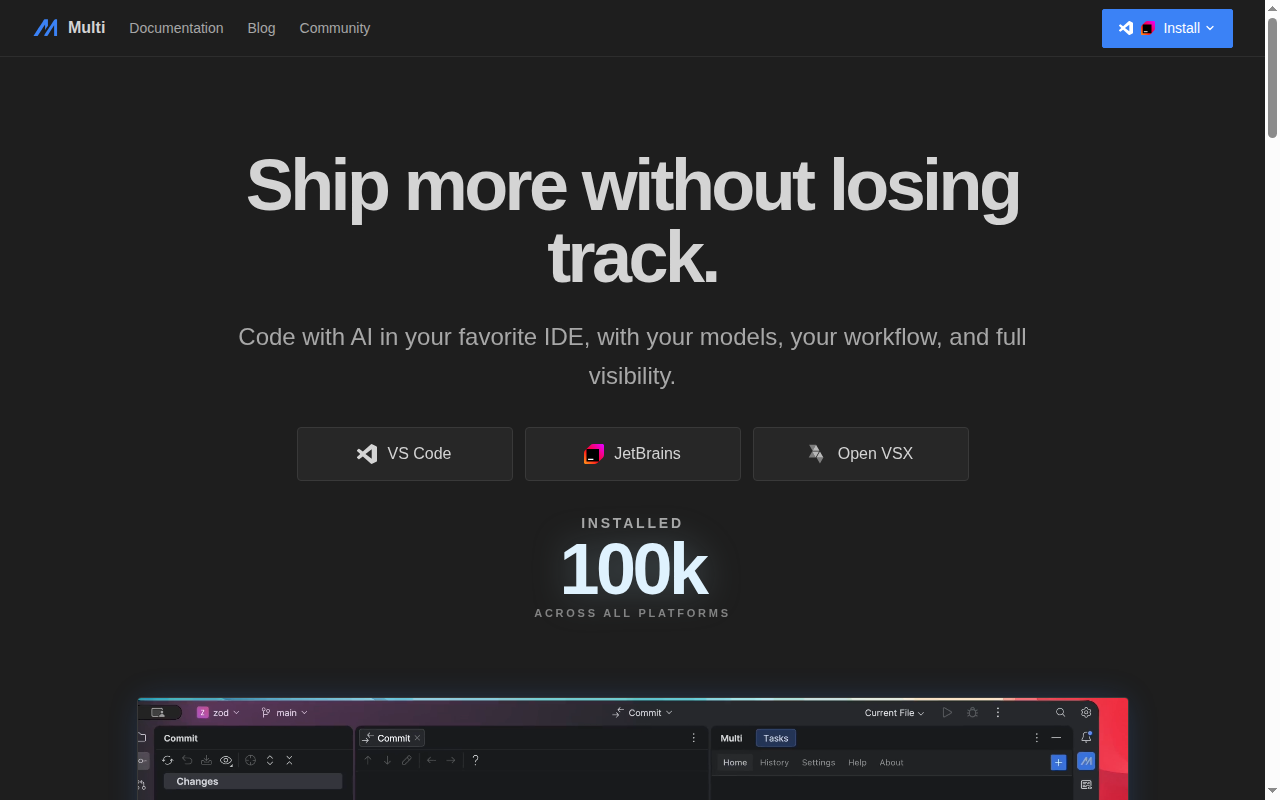
Multi: A GitHub Copilot Alternative for IDE Extension Workflows
Multi is a ide extension developed by Multi. A free AI coding agent that plugs into VS Code, JetBrains IDEs, Cursor, Windsurf, Kiro, and Antigravity with bring-your-own-provider flexibility. As a GitHub Copilot alternative, it is best suited for developers and teams who want a full agent workflow inside the editors they already use, especially when they care about provider choice, reversible steps, and stronger approval controls than copilot's default experience.
Multi vs. GitHub Copilot: Quick Comparison
| Multi | GitHub Copilot |
|---|
| Type | IDE Extension | IDE Extension / CLI |
| IDEs | VS Code, JetBrains IDEs, Cursor, Windsurf, Kiro, Antigravity; CLI is listed as coming soon | VS Code, JetBrains, Vim, Neovim, Visual Studio, Xcode |
| Pricing | Free $0; Bring your own provider Usage-based | Free for students/OSS; Individual $10/mo; Business $19/mo; Enterprise $39/mo |
| Models | 36 providers including Copilot, Claude Code, Gemini CLI, OpenAI, Anthropic, OpenRouter, Bedrock, Vertex AI, Mistral, DeepSeek, Groq, xAI, and more | OpenAI GPT-4o, Claude 3.5 Sonnet, Gemini 1.5 Pro (multi-model) |
| Privacy / hosting | Runs locally inside your editor; code and API keys stay on your machine and requests go directly to the provider you choose | Cloud (GitHub/Microsoft) |
| Open source | No | No |
| Offline / local models | Limited | No |
What Multi Actually Offers
A free AI coding agent that plugs into VS Code, JetBrains IDEs, Cursor, Windsurf, Kiro, and Antigravity with bring-your-own-provider flexibility.
The official product materials position Multi as a ide extension rather than a simple autocomplete layer. That distinction matters because developers often compare Copilot with tools that solve a broader workflow problem, such as multi-step code generation, app scaffolding, cross-device development, or hosted execution environments.
From a buyer's perspective, the practical question is not whether Multi can suggest code, but whether it can improve the end-to-end work you care about. The strongest reason to shortlist Multi is that it reshapes part of the software delivery loop through checkpoints and reverts, task forking, git worktrees, auto-approval controls, token tracking, multi-provider profiles, artifacts panel, keyboard-first workflow.
Key Strengths
- Provider flexibility: Multi is built around a bring-your-own-model workflow instead of locking you into one vendor. That matters if you want to compare Copilot, Claude Code, Gemini CLI, OpenAI, or self-managed providers without leaving your editor.
- Control and reversibility: Every step is checkpointed, and the product exposes reverts, worktree isolation, and approval rules for reads, writes, commands, and plans. That gives experienced developers more operational control than lightweight autocomplete-first assistants.
- Broad editor coverage: Multi spans VS Code, JetBrains IDEs, Cursor, Windsurf, Kiro, and Antigravity from one product surface. Teams with mixed editor preferences can standardize on one agent workflow instead of fragmenting across separate tools.
Known Limitations
- No bundled model allowance: The tool is free, but model usage is not. If your team does not already manage provider accounts or API budgets, setup can feel more involved than a bundled subscription like GitHub Copilot.
- CLI still maturing: The homepage positions CLI support as coming soon. Developers who want a deeply terminal-native workflow today may prefer tools that already treat the CLI as the primary interface.
- Advanced controls can add complexity: Checkpoints, profiles, forking, and approval settings are valuable, but they also create more knobs to configure. Developers who want minimal setup may find GitHub Copilot easier to adopt at first.
Best For
Developers and teams who want a full agent workflow inside the editors they already use, especially when they care about provider choice, reversible steps, and stronger approval controls than Copilot's default experience. It is particularly compelling for teams that want more than inline completion and expect the tool to participate in planning, code generation, environment setup, or deployment. Compared with GitHub Copilot, Multi is easier to justify when the workflow itself is the product advantage, not only the model output.
In practice, Multi makes the most sense when developers are intentionally evaluating alternatives to GitHub Copilot because they want more control, a different deployment model, or broader product workflow support. If that is your situation, the product's positioning is much easier to defend than if you only need occasional inline suggestions.
Pricing
- Free: $0 — No subscription, no sign-up, no usage limits
- Bring your own provider: Usage-based — You pay your chosen AI provider directly
Prices are subject to change. Check the official pricing page for current details.
Tech Details
- Type: IDE Extension
- IDEs: VS Code, JetBrains IDEs, Cursor, Windsurf, Kiro, Antigravity; CLI is listed as coming soon
- Key features: checkpoints and reverts, task forking, git worktrees, auto-approval controls, token tracking, multi-provider profiles, artifacts panel, keyboard-first workflow
- Privacy / hosting: Runs locally inside your editor; code and API keys stay on your machine and requests go directly to the provider you choose
- Models / context window: 36 providers including Copilot, Claude Code, Gemini CLI, OpenAI, Anthropic, OpenRouter, Bedrock, Vertex AI, Mistral, DeepSeek, Groq, xAI, and more
Multi positions itself around ide extension workflows rather than just inline code suggestions. The official sources emphasize checkpoints and reverts, task forking, git worktrees, auto-approval controls, token tracking, multi-provider profiles, artifacts panel, keyboard-first workflow. When exact internal implementation details are not documented publicly, this listing calls that out instead of guessing.
One practical difference versus GitHub Copilot is operational scope. Copilot is usually easiest to understand as an assistant that lives inside an established development surface, while Multi is trying to influence how you build, review, run, or ship software across a wider workflow boundary.
When to Choose This Over GitHub Copilot
- Choose Multi over GitHub Copilot when you want to switch between many providers and models from one interface.
- Choose Multi when checkpointing, reverts, worktrees, and approval controls matter more than a simpler out-of-the-box setup.
- Choose Multi when your team works across VS Code, JetBrains, Cursor, and Windsurf and wants one shared agent workflow.
These advantages are strongest when your team has already outgrown a one-size-fits-all coding assistant. If you find yourself wanting more control over providers, architecture flow, local execution, or full-stack generation, Multi starts to look less like a niche alternative and more like a better category fit.
When GitHub Copilot May Be a Better Fit
- GitHub Copilot may be a better fit if you want the simplest mainstream setup with a bundled commercial product and fewer configuration choices.
- Copilot can be easier for organizations already standardized on GitHub-native workflows and enterprise procurement around GitHub.
- Copilot may feel more straightforward for developers who mainly want inline completion and lightweight chat rather than a fuller agent control surface.
This is an important trade-off to be honest about. The best Copilot alternatives are not always better in every dimension. They are better for specific constraints, such as local-first operation, richer app scaffolding, stronger review controls, or a browser-native environment.
How It Compares in Real Evaluation Scenarios
When teams compare Multi against GitHub Copilot, the conversation usually comes down to one of four things: setup friction, provider choice, workflow coverage, and governance. Multi competes best when its broader workflow story solves a real pain point, because that creates a durable reason to switch instead of a novelty-based reason.
A second consideration is commercial clarity. Multi publishes a product story and pricing model that can be compared with Copilot at the budget-planning stage. That matters for founders, engineering managers, and consultants who need to decide whether they are paying for model access, developer control, app-building leverage, or all three together.
Finally, there is the question of user fit. Some developers will prefer the familiarity of GitHub Copilot because it stays out of the way. Others will prefer Multi because it creates a more opinionated and productive workflow. A good shortlist decision should match the work style of the team, not only the benchmark reputation of the model behind it.
Operational Fit and Adoption Notes
Multi is easiest to justify when a team already cares about model routing, approval rules, and repeatable agent behavior across editors. In that situation, it is not just another autocomplete product. It is a workflow layer that gives teams more control over how AI coding happens day to day.
That changes onboarding expectations. A developer who only wants quick inline suggestions may initially see more surface area than they need, while a platform-minded team may see stronger governance and better reuse of existing provider accounts. This makes Multi particularly relevant for teams that treat AI coding as an operational system rather than a lightweight assistant.
The same point matters commercially. A bundled assistant can be simpler to buy, but harder to adapt when preferred models, pricing, or latency targets change. Multi asks for more setup up front, yet it gives teams a cleaner path to switch providers later without replacing the rest of their workflow.
Conclusion
Multi is a credible choice for developers who like the idea of AI-assisted coding but want a different operating model from GitHub Copilot. If you value ide extension depth, workflow control, or deployment scaffolding more than Copilot's mainstream simplicity, Multi is worth serious consideration. If your priority is a lighter, conventional assistant inside an existing GitHub-heavy setup, GitHub Copilot can still be the easier fit.
Sources
FAQ
Is Multi free?
Yes. Multi advertises itself as completely free, with no subscription, no sign-up, and no usage limits. The cost comes from whichever AI provider you connect.
Does Multi work with JetBrains and VS Code?
Yes. Multi officially supports VS Code, JetBrains IDEs, Cursor, Windsurf, Kiro, and Antigravity from the same product family.
Can Multi replace GitHub Copilot?
For many developers, yes. It covers agentic coding tasks, model switching, code exploration, and command execution, but the best fit depends on whether you value flexibility over simplicity.
Does Multi keep code local?
The product says it runs locally and keeps code and keys on your machine while sending requests directly to the provider you choose.